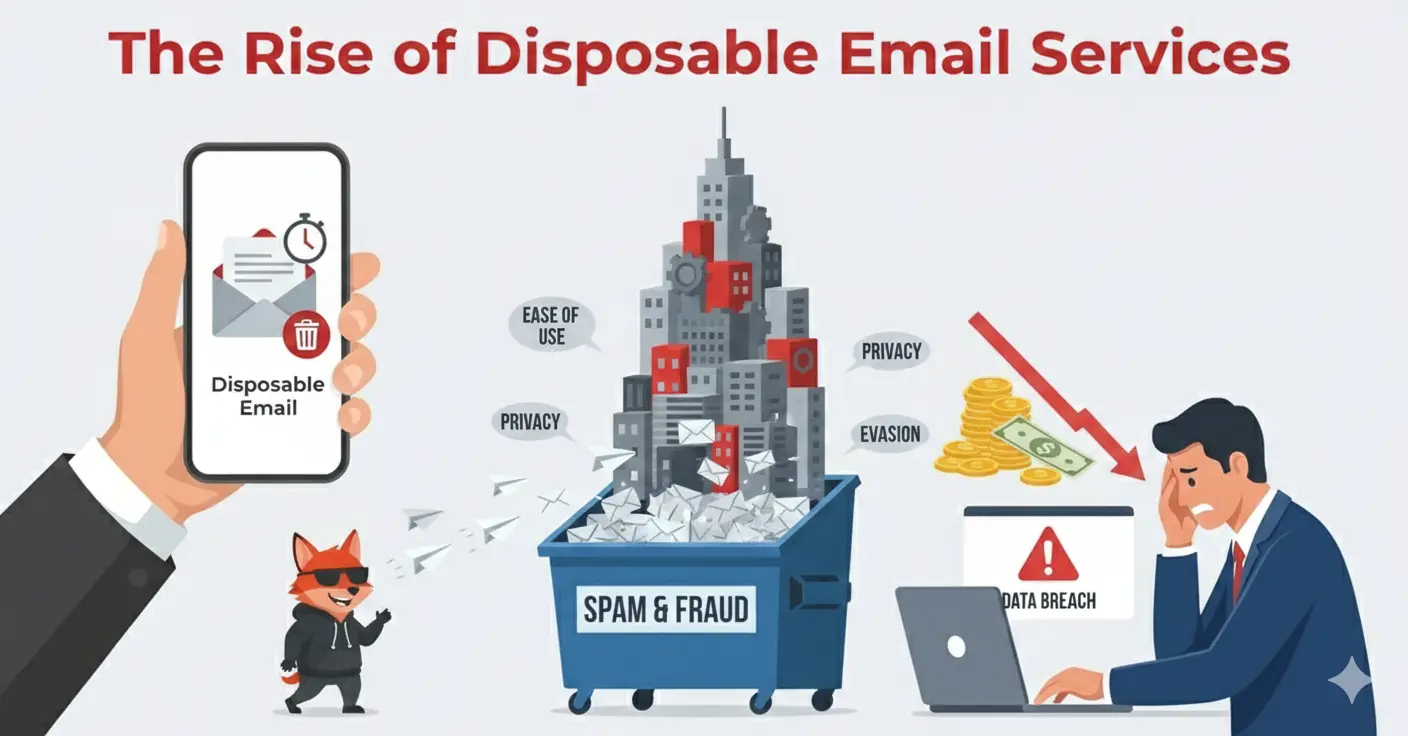
Disposable email services have grown from a niche privacy tool into a massive ecosystem that processes millions of temporary inboxes daily. Understanding why they exist, how they work, and how the landscape is evolving is essential for any business that collects email addresses. This isn't a problem you can ignore — it's a structural feature of the modern internet.
A Brief History
The first disposable email services appeared in the early 2000s as a response to spam. The premise was simple: instead of giving every website your real email address (and inevitably getting spammed), create a throwaway address that forwards to your real inbox, then delete it when the spam starts flowing.
Mailinator, launched in 2003, was one of the pioneers. It offered public disposable inboxes that anyone could check — no signup required. You'd give a website "anything@mailinator.com", then check the inbox at mailinator.com to grab the confirmation email. Simple, free, and effective.
By 2010, dozens of services had appeared: Guerrilla Mail, Temp Mail, ThrowAwayMail, YOPmail, and others. Each offered a slightly different approach — some had private inboxes, some lasted longer, some offered SMTP access. But the core proposition was the same: protect your real email from unwanted communication.
The Current Ecosystem
Today, the disposable email landscape is vast. At Mailchk, our AI crawler tracks over 75,000 domains associated with disposable email services, and the number grows daily. The ecosystem has stratified into several categories:
Classic Disposable Services
Services like Temp Mail and Guerrilla Mail remain popular. They provide a random email address, let you receive messages for 10-60 minutes, and then destroy the inbox. No signup required, no identity linked. These handle millions of emails daily.
Alias and Forwarding Services
A newer category that blurs the line between disposable and privacy tool. Apple's Hide My Email, Firefox Relay, and SimpleLogin generate unique aliases that forward to your real address. You can revoke any alias individually without affecting the others. These are harder to detect because they use the services' primary domains and have legitimate MX records.
Self-Hosted Solutions
Open-source projects like AnonAddy and SimpleLogin (before its acquisition by Proton) let technically inclined users run their own alias services on custom domains. This makes detection nearly impossible through domain-based blocklists because the domains are unique and indistinguishable from regular email hosting.
Crypto and Privacy-Focused Services
ProtonMail and Tutanota, while not disposable services, are increasingly used as pseudonymous email providers. Their focus on privacy and lack of phone number requirements makes them popular with users who want to compartmentalize their online identity. For businesses, these represent valid but potentially lower-engagement users.
Why People Use Disposable Email
It's tempting to paint all disposable email users as bad actors, but the reality is more nuanced. Understanding their motivations helps you design better policies.
Spam Avoidance
The original and still most common reason. Users have been burned by companies selling their email addresses or sending relentless marketing campaigns. They don't trust that your unsubscribe link works, so they never give you a real address in the first place. This is a trust problem — and it's partially the industry's own fault.
Privacy Concerns
Post-GDPR, post-Cambridge Analytica, many users are genuinely concerned about data privacy. They don't want their email address connected to every account across the internet, especially for services they're just trying out. This is particularly common in Europe and among younger, privacy-aware demographics.
Free Tier Abuse
This is where disposable emails become a business problem. Users create multiple accounts to exploit free-tier limits, stack signup discounts, or abuse promotional offers. A single user with 10 disposable email addresses looks like 10 different customers in your database.
Avoiding Account Tracking
Some users use disposable emails to prevent companies from building profiles across services. If you sign up for a retail site with your primary Gmail address, that address becomes a key that advertisers use to connect your behavior across platforms. Disposable addresses break this chain.
Testing and Development
Developers frequently use disposable emails to test signup flows, email verification systems, and other account-related features. This is legitimate and expected — but it can inflate your signup metrics if you're not filtering test accounts.
The Scale of the Problem
How big is disposable email usage? Exact numbers are hard to pin down, but available data paints a clear picture:
- Temp Mail alone reports over 2 billion emails processed since its launch
- Guerrilla Mail processes 12+ million emails per day
- Apple's Hide My Email has been available to hundreds of millions of iCloud users since 2021
- Our data at Mailchk shows that 8-15% of signups on unprotected forms use disposable addresses, with some industries (gaming, crypto, content downloads) seeing rates above 30%
The Arms Race
The dynamic between disposable email providers and detection services has the characteristics of an arms race, and both sides are getting more sophisticated.
Disposable Services Are Evolving
Early disposable services used obvious, well-known domains that were easy to blocklist. Modern services have adapted:
- Domain rotation: Services register new domains frequently and retire old ones, making static blocklists obsolete within days.
- Wildcard domains: Some services accept email at any subdomain, generating effectively infinite addresses from a single domain.
- Integration with legitimate infrastructure: Some disposable services use domains that also host legitimate websites, making domain-based blocking a false positive risk.
- API-driven generation: Services like Temp Mail offer APIs that bots can use to programmatically generate thousands of addresses per minute.
Detection Is Evolving Too
Traditional detection relied on manually curated blocklists. Someone discovers a new disposable domain, adds it to a list, and the list gets distributed. This reactive approach always lagged behind new services by days or weeks.
Modern detection uses multiple signals:
- AI-powered domain classification: Machine learning models trained on domain characteristics (DNS patterns, hosting infrastructure, registration details) can identify disposable domains without prior knowledge. This is the approach Mailchk uses.
- Real-time crawling: Automated crawlers scan the web for new disposable email services, test them, and add confirmed domains to the detection database within hours.
- Behavioral analysis: Looking at patterns beyond the email address itself — signup velocity, IP reputation, browser fingerprinting — to identify abuse even when the email domain isn't flagged.
What Businesses Should Do
Accept the Reality
Disposable emails aren't going away. The privacy motivations behind them are legitimate, and mainstream platforms (Apple, Mozilla) are building disposable-like features into their products. Your strategy should be mitigation, not elimination.
Differentiate Between Privacy and Abuse
A user who signs up with Apple's Hide My Email and becomes a paying customer is valuable despite using an alias. A user who creates 50 accounts with Temp Mail addresses to exploit your free tier is not. Your validation policy should distinguish between these scenarios — risk scoring is more useful than binary blocking.
Use Real-Time Detection
Static blocklists are not enough. If your detection relies on a list that was last updated a week ago, hundreds of new disposable domains have been missed. Use a detection service with AI-powered, real-time discovery.
Combine Signals
Email validation alone won't catch everything. Combine it with other signals: rate limiting by IP, browser fingerprinting for repeat offenders, phone number verification for high-value actions, and behavioral analysis for post-signup abuse detection.
Looking Ahead
The trend toward email privacy tools will accelerate. Apple, Google, and Mozilla are all investing in email aliasing and forwarding features that make it easier for users to compartmentalize their email identity. For businesses, this means the distinction between "disposable" and "private" will blur further.
The businesses that thrive will be those that earn users' trust — making it unnecessary for legitimate users to hide behind disposable addresses — while maintaining robust detection for actual abuse. Email validation is one piece of that puzzle, but it needs to be intelligent, nuanced, and constantly evolving.