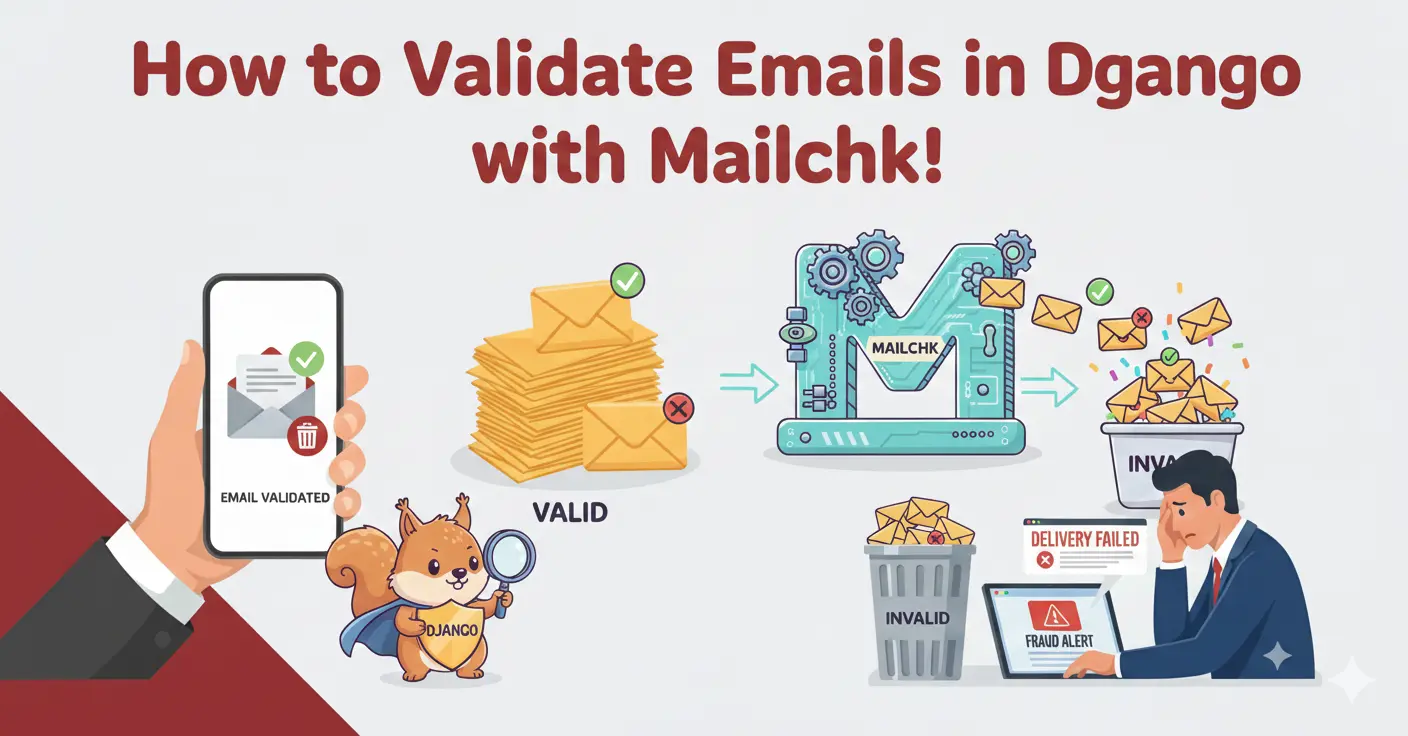
Django's form and model validation system makes it straightforward to add external email validation. This guide shows how to integrate Mailchk using a custom validator, a service with caching, and DRF serializer integration.
Step 1: Validation Service
# utils/email_validation.py
import requests
from django.conf import settings
from django.core.cache import cache

def validate_email_address(email: str) -> dict:
    cache_key = f"email_validation:{email}"
    cached = cache.get(cache_key)
    if cached is not None:
        return cached

    try:
        response = requests.post(
            "https://api.mailchk.io/v1/check",
            json={"email": email},
            headers={
                "X-API-Key": settings.MAILCHK_API_KEY,
                "Content-Type": "application/json",
            },
            timeout=5,
        )
        response.raise_for_status()
        result = response.json()
    except requests.RequestException:
        result = {"valid": True, "disposable": False}

    cache.set(cache_key, result, timeout=86400)
    return result
Step 2: Custom Validator
# validators/email.py
from django.core.exceptions import ValidationError
from utils.email_validation import validate_email_address

def validate_real_email(email: str) -> None:
    result = validate_email_address(email)

    if not result.get("valid", False):
        raise ValidationError("Please enter a valid email address.")

    if result.get("disposable", False):
        raise ValidationError("Disposable email addresses are not allowed.")
Step 3: Use in Models and Forms
# models.py
from validators.email import validate_real_email

class User(models.Model):
    email = models.EmailField(unique=True, validators=[validate_real_email])

# forms.py
class SignupForm(forms.Form):
    email = forms.EmailField(validators=[validate_real_email])
    password = forms.CharField(widget=forms.PasswordInput)
Django REST Framework Integration
# serializers.py
from rest_framework import serializers
from utils.email_validation import validate_email_address

class SignupSerializer(serializers.Serializer):
    email = serializers.EmailField()
    password = serializers.CharField(min_length=8)

    def validate_email(self, value):
        result = validate_email_address(value)

        if not result.get("valid"):
            raise serializers.ValidationError("Invalid email address.")
        if result.get("disposable"):
            raise serializers.ValidationError("Disposable emails not allowed.")

        if result.get("did_you_mean"):
            self.context["email_suggestion"] = result["did_you_mean"]

        return value
Async Support (Django 4.1+)
import httpx

async def validate_email_async(email: str) -> dict:
    async with httpx.AsyncClient() as client:
        response = await client.post(
            "https://api.mailchk.io/v1/check",
            json={"email": email},
            headers={"X-API-Key": settings.MAILCHK_API_KEY},
            timeout=5.0,
        )
        return response.json()
Best Practices
- Cache results — use Redis or Memcached in production for fast lookups.
- Fail open — allow signups if the validation service is temporarily unreachable.
- Use the typo suggestion — return
did_you_meanto the user as a helpful prompt. - Validate in forms/serializers, not views — keeps validation reusable across your app.
Getting Started
Get your free API key at mailchk.io/signup. 200 validations/month free, sub-50ms response times.