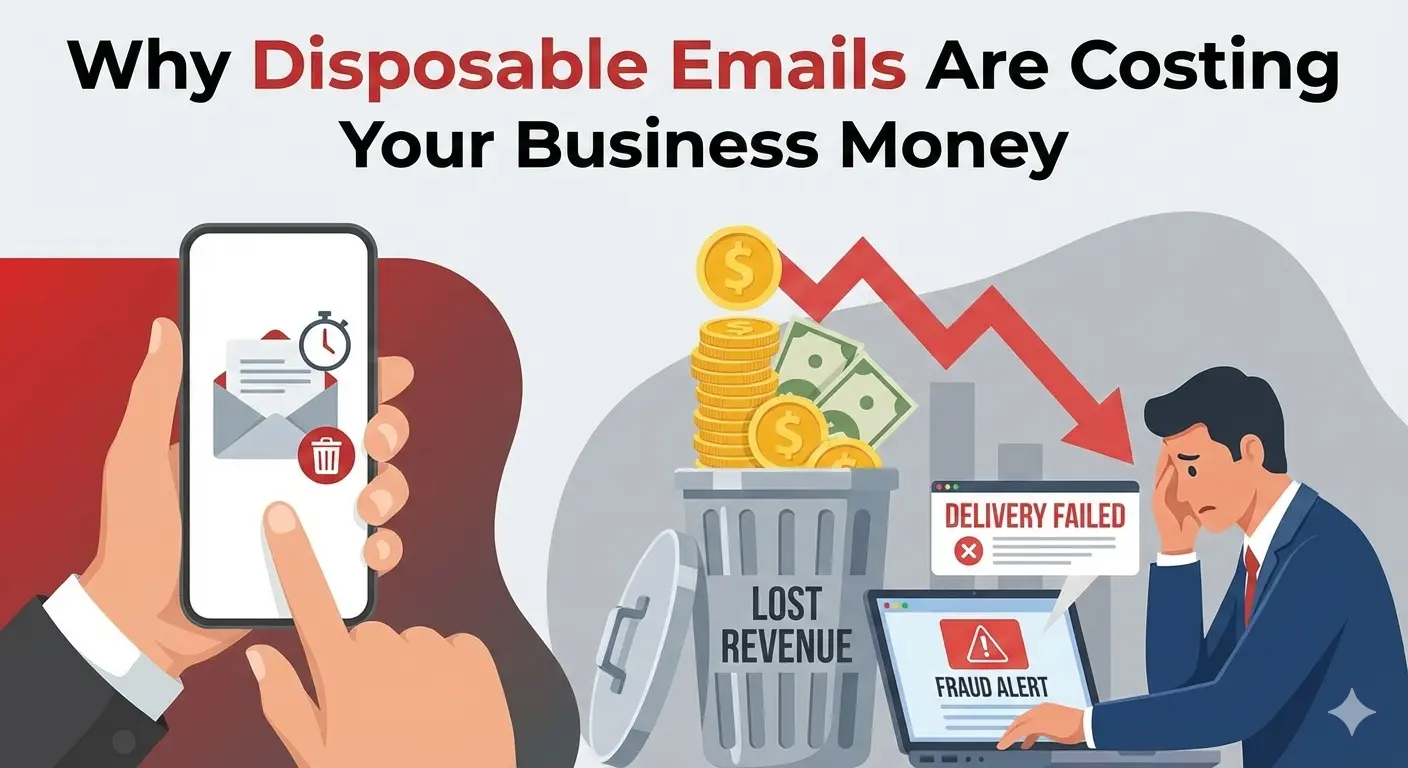
Every business that collects email addresses faces the same hidden problem: disposable emails slipping through signup forms, inflating metrics, and quietly draining budgets. If you've ever looked at your email list and wondered why open rates are plummeting or why your free-tier costs keep climbing, throwaway addresses are almost certainly part of the answer.
What Are Disposable Emails?
Disposable email services — Guerrilla Mail, Temp Mail, 10MinuteMail, and hundreds of others — generate temporary inboxes that self-destruct after minutes or hours. Users create them in seconds, use them to bypass signup gates, and never check them again. The inbox vanishes, but the fake account persists in your database.
The ecosystem has exploded. Our AI-powered crawler at Mailchk tracks over 75,000 disposable domains, and new ones appear daily. Traditional blocklists can't keep up because anyone can register a new domain and spin up a disposable email service in an afternoon.
The Real Cost to Your Business
1. Inflated User Counts
Disposable emails create phantom users. They sign up, grab whatever free resource you offer, and disappear. Your dashboard shows 10,000 signups, but 15-25% of those accounts will never convert, never engage, and never generate revenue. You make strategic decisions — hiring, infrastructure spending, fundraising projections — based on numbers that don't reflect reality.
2. Destroyed Email Deliverability
When you send campaigns to addresses that no longer exist, you get hard bounces. Email service providers like Gmail and Outlook watch your bounce rate closely. Exceed 2-3% and you start landing in spam folders — not just for the dead addresses, but for your legitimate subscribers too. A single campaign sent to a list contaminated with disposable addresses can damage your sender reputation for weeks.
3. Wasted Marketing Spend
Most email marketing platforms charge by subscriber count. If 20% of your list is disposable addresses, you're paying 20% more for your email tool every single month. For a company with 50,000 subscribers on a platform like Mailchimp, that's roughly $100-200/month thrown away on addresses that will never open an email.
Beyond the platform cost, every nurture sequence, onboarding email, and promotional campaign you send to a disposable address costs time and resources to create, with zero chance of return.
4. Skewed Analytics
Disposable email users distort every metric you track. Signup conversion rates look higher than they are. Activation rates look lower because phantom users never complete onboarding. Cohort analyses become unreliable. A/B tests produce misleading results because a chunk of your test group was never real to begin with.
Product teams make decisions based on these metrics. If your onboarding completion rate drops from 60% to 45%, the natural response is to redesign the onboarding flow. But if the drop is caused by disposable email signups who were never going to complete onboarding regardless, you've just spent engineering time solving the wrong problem.
5. Support and Infrastructure Burden
Every fake account consumes database storage, occupies a row in your user table, and may trigger automated processes — welcome emails, trial provisioning, API key generation. If you offer a free tier with compute resources, disposable email users can create multiple accounts to abuse those resources repeatedly.
We've seen SaaS companies where 30% of their free-tier infrastructure costs were attributable to throwaway accounts that signed up, consumed resources for a few hours, and never returned.
Industries Hit Hardest
SaaS and API Products
Free trials and freemium models are prime targets. Users create disposable accounts to get perpetual free access, cycling through new email addresses every time a trial expires. One disposable email user can cost a SaaS company hundreds of dollars in compute over a year.
E-commerce
Coupon abuse is rampant. "Sign up for 15% off your first order" promotions attract disposable email users who create a new account for every purchase, stacking discounts that were meant to be one-time incentives. A retailer running a 15% signup discount with 1,000 disposable signups per month could be losing $5,000-15,000 in margin annually.
Content Platforms
Paywalled content, gated downloads, and lead magnets all attract disposable email abuse. Your content marketing team creates a valuable whitepaper to generate leads, but 40% of the downloads come from throwaway addresses that will never enter your sales funnel.
How to Fight Back
Validate at the Point of Entry
The most effective defense is real-time email validation on your signup form. When a user enters a disposable email address, block it immediately and ask for a permanent address. This is a one-time API call that takes under 50 milliseconds — your users won't even notice the check happening.
Go Beyond Static Blocklists
Traditional disposable email detection relies on static lists of known domains. The problem is that new disposable services launch constantly, and some services generate random subdomains that are impossible to pre-list. You need AI-powered detection that discovers new disposable domains in real time.
At Mailchk, our AI agent crawls the web 24/7, discovering and classifying new disposable email domains as they appear. This means we catch new services within hours of their launch, not weeks.
Use Risk Scoring, Not Binary Decisions
Not every suspicious email should be outright blocked. Some domains are borderline — small ISPs that share characteristics with disposable services, or catch-all domains that might be legitimate businesses. A risk scoring system lets you make nuanced decisions: low-risk emails pass through, medium-risk emails trigger additional verification (like email confirmation), and high-risk emails are blocked.
Clean Your Existing List
If you haven't been validating emails at signup, your existing database likely contains thousands of disposable addresses. Run a bulk validation to identify and remove them. This alone can improve your email deliverability metrics within days.
The ROI of Email Validation
Let's do simple math. Assume you have 25,000 email subscribers and 18% are disposable or invalid:
- Email platform savings: 4,500 fewer subscribers = $50-100/month saved
- Deliverability improvement: Removing dead addresses improves inbox placement by 10-20%, meaning more real customers see your emails
- Accurate analytics: Product and marketing decisions based on real data, not phantom users
- Reduced abuse: Free-tier and coupon abuse drops dramatically
At Mailchk, validating 25,000 emails costs a fraction of the monthly savings you'll see from cleaner data alone. It's one of the rare investments in your stack that pays for itself immediately.
Start Protecting Your Business
Disposable emails aren't going away — the services are too easy to create and too useful for users who want to avoid spam. The question isn't whether they're affecting your business, but how much. Start with a free Mailchk account (200 validations/month, no credit card required), run your signup list through our API, and see the results for yourself.